
Category: Best Dog Walkers

Types of collars for sighthounds, and why they matter:

Types of collars for sighthounds, and why they matter:

Sighthounds are unlike any other group of dogs. From Greyhounds and Whippets to Salukis, Borzoi, and Italian Greyhounds, these breeds share a distinctive silhouette—long, elegant necks, narrow heads, deep chests, and lean bodies built for speed. Those same traits that make them such breathtaking athletes also mean they have very specific equipment needs, especially when it comes to collars for sighthounds.

One of the most defining characteristics of a sighthound is that their head is often narrower than their neck. In practical terms, this means many standard flat collars can slip off with surprising ease—particularly if a dog startles, pulls backward, or becomes frightened. Add to that their thin skin, low body fat, and overall sensitivity, and it becomes clear that not every collar is suitable for these breeds.

Choosing the right collar for a sighthound isn’t just about style—it’s about safety, comfort, and proper support for their unique anatomy. In this article, we’ll explore the most commonly used types of collars designed specifically with sighthounds in mind, how they function, and when each option may be appropriate. We’ll also include a brief honorary mention of harnesses, which can be an excellent alternative in certain situations.

The Martingale Collar:
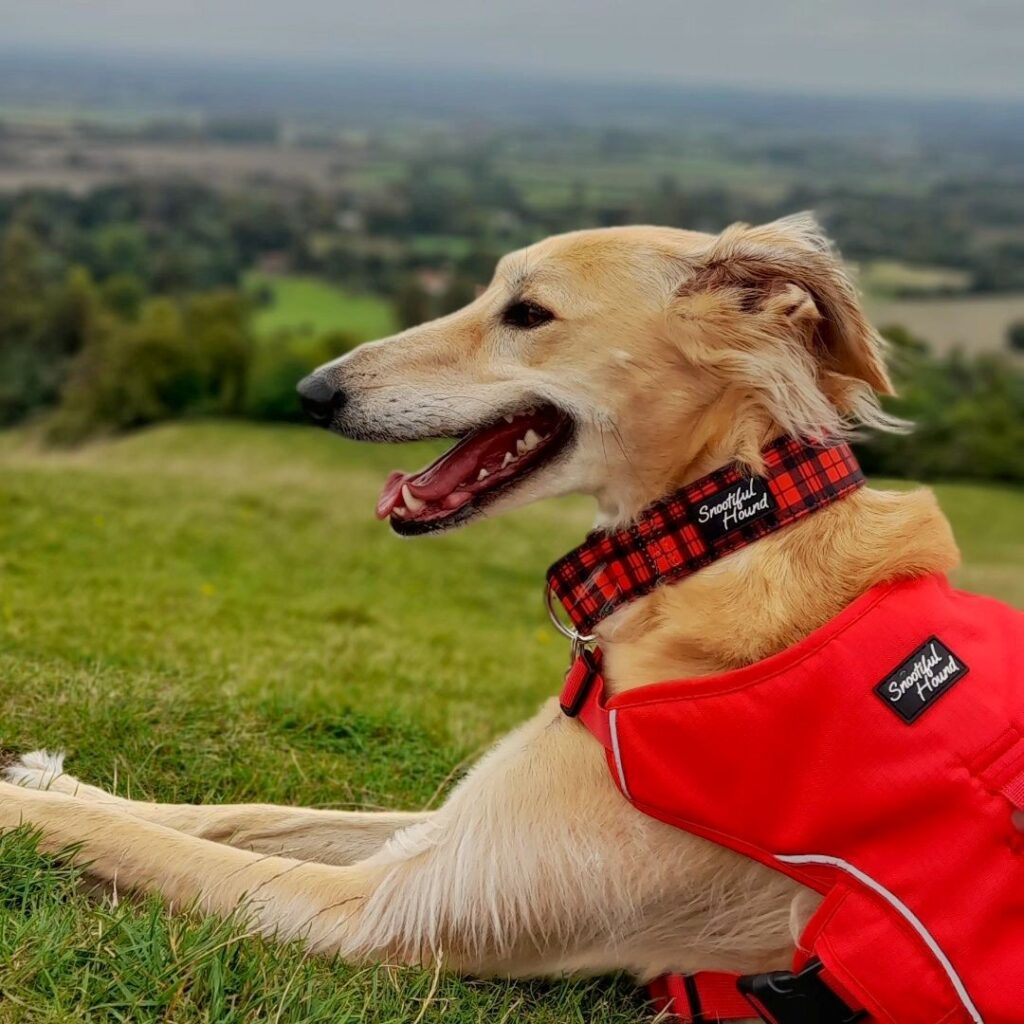
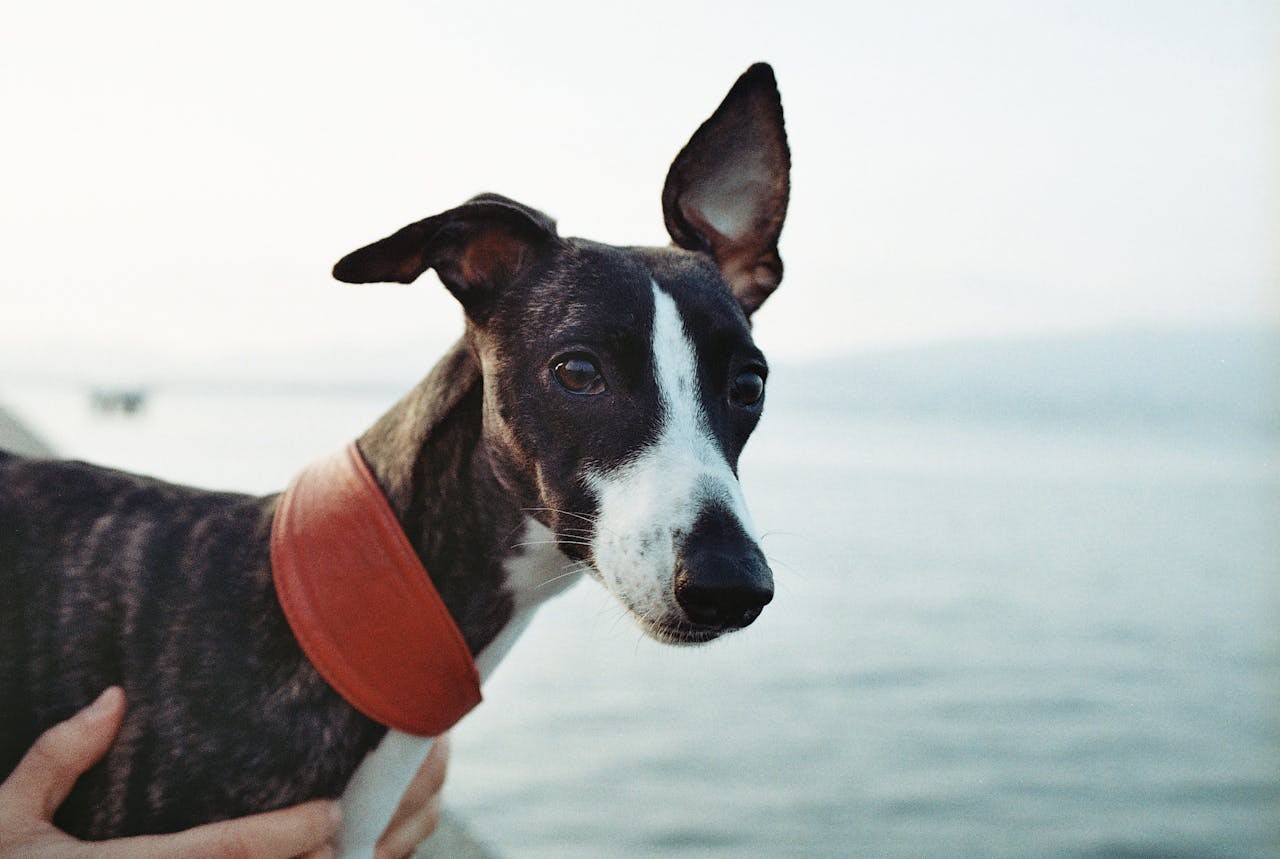
If there is one collar most commonly associated with sighthounds, it is the martingale collar which was specifically designed to address the unique anatomy of breeds whose necks are wider than their heads. For many sighthound owners, it is considered the gold standard for everyday walking.

A martingale collar features two loops. The larger loop sits around the dog’s neck, while the smaller control loop tightens gently when tension is applied to the leash. When the dog pulls or attempts to back out, the collar tightens just enough to prevent escape but not enough to cause discomfort or injury. Unlike a choke chain, it does not continue tightening indefinitely. Once tension is released, the collar loosens again, resting comfortably around the neck.

This design makes the martingale particularly well-suited for sighthounds. Because these breeds can easily slip out of traditional flat collars, the gentle tightening action adds an important layer of security. These collars also tend to be wider than a traditional collar, so it also distributes pressure more evenly around the neck compared to narrower collars, which is beneficial for sighthounds who can accelerate fast, and have thin fragile necks.

Martingales are commonly used for daily walks, leash training, and outings where added control is needed. They are especially valuable for newly adopted sighthounds, who may be more prone to spooking or attempting to back away when startled.

Martingales are commonly used for daily walks, leash training, and outings where added control is needed. They are especially valuable for newly adopted sighthounds, who may be more prone to spooking or attempting to back away when startled.

Leather Fishtail Collars – the traditional choice:
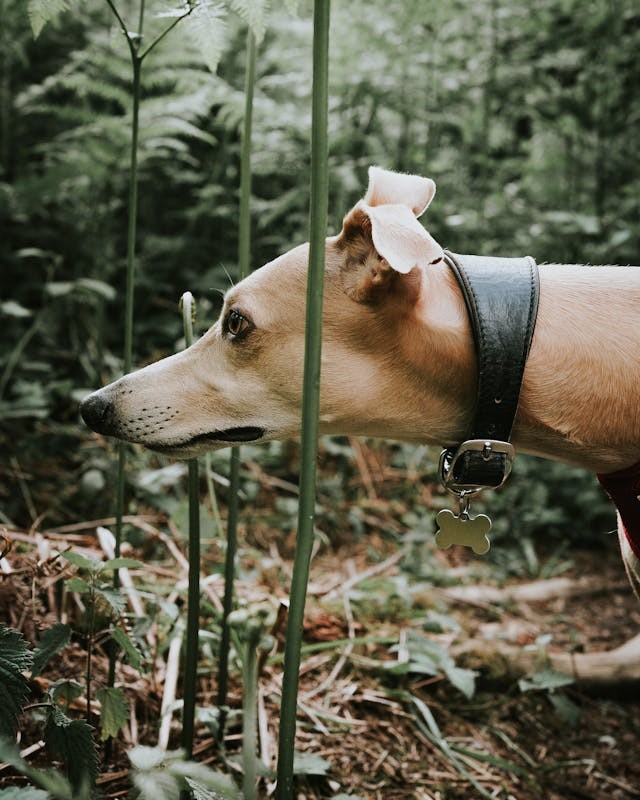
The leather fishtail collar is one of the most iconic pieces of traditional sighthound equipment. Recognisable by its distinctive flared shape—wide across the front of the neck and tapering toward the buckle—it was specifically developed to support the long, slim necks of sighthounds. The widened front section helps distribute pressure across a greater surface area, offering both comfort and structural support where it’s needed most.

Unlike standard straight collars, the fishtail shape follows the natural curve of a sighthound’s neck. The broader front panel helps protect the more delicate cervical area while preventing the collar from digging in during leash pressure. This can be particularly beneficial for dogs with very fine skin or those prone to irritation from narrower designs.

Traditionally crafted from leather, fishtail collars are valued not only for their function but also for their durability and classic aesthetic which is timeless in the sighthound community.

High-quality leather softens and molds slightly to the dog’s neck over time, improving comfort with wear. However, proper fit is essential—these collars should sit comfortably high on the neck without sliding down toward the shoulders. While they offer excellent support and style, fishtail collars are generally best suited for calm walkers who are unlikely to back out of a collar, as they do not provide the same escape resistance as a martingale.

House Collars – an extra layer of protection:

House collars are not designed for walking, but rather for identification in case your hound gets loose. These collars are typically lightweight, minimal in structure, and made from soft materials that can be worn comfortably for extended periods indoors.

For sighthounds, this distinction is especially important. Because they have thin skin and very little natural padding around the neck, constant pressure from a heavier walking collar can sometimes cause irritation or coat wear. A lightweight house collar reduces that risk while still ensuring that ID tags remain attached in case of an unexpected escape which can happen often with sighthounds, especially when travelling.

Many sighthound owners prefer to use a dedicated walking collar, such as a martingale or fishtail, for outings, and switch to a softer tag collar at home which is more comfortable for the dog. House collars are often designed to be unobtrusive—thin leather, soft fabric, or even breakaway styles are common choices.

While they are ideal for holding identification tags, house collars should not be relied upon for leash walking. Used appropriately, however, they provide a practical and gentle way to ensure a sighthound is always wearing proper identification.

Honorary Mention: Harnesses for Sighthounds
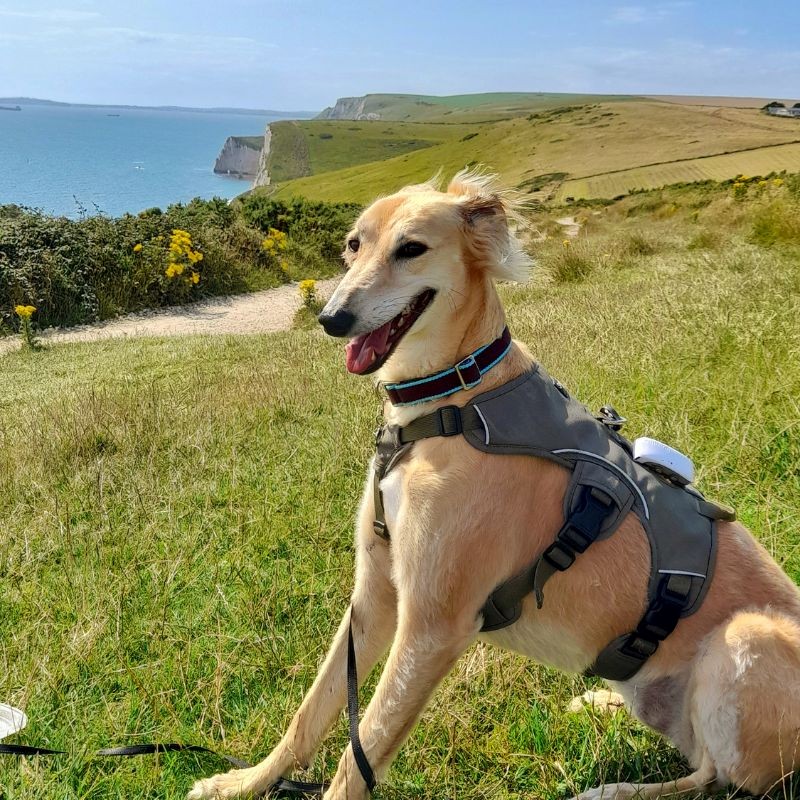
While collars are the traditional choice for many sighthound owners, a good sighthound harness can be an excellent alternative—or complement—depending on the individual dog. Because sighthounds have long, delicate necks and relatively little body fat, some owners prefer to reduce or eliminate leash pressure on the neck altogether. In certain situations, a properly fitted harness may provide added safety and comfort.

However, if choosing a harness, fit and design are absolutely critical. A poorly fitted harness, or one that overlooks the unique needs of a sighthound, can restrict shoulder movement, rub against sensitive skin, or even allow a determined sighthound to escape.

For deep-chested breeds, three-point (often called escape proof) harnesses are especially popular. These designs include an additional strap that sits behind the ribcage, making it much harder for a dog to back out.

Other important considerations is to get one with a Y-shaped chest piece and padding in the appropriate places to reduce rubbing and to avoid restricting movement.

Conclusion:

Sighthounds are beautifully unique dogs, and their equipment should reflect that. Their narrow heads, long necks, deep chests, and sensitivity make proper collar selection more than just a matter of preference—it’s a matter of safety and comfort.

For many owners, the martingale remains the go-to choice for secure everyday walks, offering gentle control while helping to prevent escapes. Leather fishtail collars provide traditional support and elegant structure, distributing pressure across the neck in a way that suits the sighthound’s unique anatomy. House collars serve a different but equally important role, ensuring identification without unnecessary weight or irritation during downtime at home if you’re worried about your hound getting out unexpectedly. Harnesses, when properly fitted, can offer an excellent alternative in situations where reducing neck pressure or increasing security is a priority, and also allow for safe travel in a car.

There is no single “perfect” option for every dog. The right choice depends on your sighthound’s temperament, training, physical sensitivity, and lifestyle. By understanding how each type of collar—or harness—functions, you can make an informed decision that prioritises both safety and comfort.

10 Facts About Golden Retrievers

10 Facts About Golden Retrievers

Dogs hit first on the list of most preferred pets. No one can doubt their preference due to their loving and caring nature, making them the best emotional support animal. There are a variety of emotional support dog breeds to choose from. Still, Golden retrievers are among the most popular family pet dog breeds across the world. They are originally from Scotland and they are in the retrievers’ dog family which has 5 other breeds. Pups are always loving, caring, and affectionate to their companions and those who own golden retrievers can attest to this.

Golden retrievers are well known for their nice golden coat color, floppy ears, and beautiful feathering. These beautiful pups were initially bred to retrieve birds for hunters but nowadays they are very popular family pets, service, and therapy dogs.

Owners of golden retrievers will always enjoy playing with them, especially with interactive toys because these pups are very energetic and they endlessly fetch whatever toy you toss to them.

In this post, we will cover what you need to know about golden retrievers and help you figure out what you can expect when you have one. We will also take you through 10 facts about golden retrievers including some that you probably did not know before.

Facts About Golden Retrievers

Breed name: Golden Retrievers

Country of origin: Scotland

Size: Large

Weight: 25 kg – 35 kg

Color: Golden, red, and cream shades.

Average life expectancy: 10 – 13 years

Activity level: High

Barking Level: Medium

Shedding: High

The Appearance of Golden Retrievers

Golden retrievers are a beauty to behold thanks to their feathering coat, long muzzle, and floppy ears. They are large dog breeds with medium-sized fur which have various shades of golden color from dark to light. The golden retriever has a beautiful double coat which is made of two layers; an outer water-resistant one and an inner soft layer to regulate his temperatures.

Being a double-coated dog, you will expect your golden retriever to shed some fur. We recommend using good dog brushes to polish his coat regularly to prevent heavy blowouts. Proper brushing also helps to remove dirt and other debris material from your retriever’s coat.

The ideal weight of this dog breed is 25 kg – 35 kg when fully grown which stands at up to 60 cm. There is a short dog breed known as mini golden retriever which maintains his puppy looks even when fully grown. Even though they appear like golden retrievers, the mini is a crossbreed of other dogs which limits his attainment of full body size and other characteristics.

10 Facts About Golden Retrievers

1.  Golden retrievers History

The golden retriever can be traced from the highlands of Scotland in the 1800s where it was used by hunters to retrieve gunned down waterfowls and to this date, they love swimming and playing in the water. During this period, wild birds hunting was a very popular sport for the wealthy Scottish people.

The then retriever dog breeds were not very efficient in retrieving gunned-down birds, especially in water. A yellow retriever dog known as nous was hybridized with a tweed water spaniel known as Belle and resulted in the golden retriever breed as we know it today. The history of golden retrievers is accredited to Dudley Marjoribanks who later became widely known as Lord Tweedmouth. This dog breed makes an excellent family pet and it can also be easily trained to lead the blind.

2.  Golden retrievers are playful

For a dog that was bred for purposes of sporting activities, we can least expect him to be very engaging and playful. The golden retriever dogs are very active and playful even around children and strangers. Despite their outgoing nature, these pups are also very gentle with kids.

This personality of golden retrievers makes them a very good family dog that blends in well with their companions and other pets. Based on some information on golden retrievers, they display a high tolerance to pain and they can hide injuries that most dog breeds would not. Always ensure you monitor your dog when playing to avoid any hazard that may injure him.

3.  The third most popular dog in America

It is with no doubt that golden retrievers are very popular among many families across the world due to their gentle nature among many other lovable traits. In the United States, this dog breed is listed as the third most popular and it has stayed in the top ten positions for decades.

The golden retriever was first introduced to the US in 1920, and five years later, it was registered by the American Kennel Club.

Cousins to the golden retrievers, the Labrador retrievers, have held the position as the most popular dog in America for over 25 years.

4.  They are easy to train

Every pet parent would love to own a dog who can easily be trained and show good progress. The golden retriever breed stands out as one of the dog breeds that are very trainable. These dogs have with this regard been used as service dogs in various situations.

When Tweedmouth bred the golden retriever, he was looking for a breed that can easily work with humans and help them out in sporting activities. He never got it wrong. The Golden retrievers are very intelligent, loyal, obedient, and easy to please. According to evaluation research in the book, The Intelligence of Dogs by Stanley Coren, golden retrievers came out as the 4th most intelligent out of 138 assessed dog breeds. When you combine their great brain and motivation to obey and please people, you get a dog breed that becomes much easier to train.

It comes with no surprise that the Golden retriever won the AKC National Obedience Championship in 2018 beating 9 other contestants.

This does not however mean that training your golden retriever will be a complete walk in the park. If you are looking forward to adopting one, then training him will be a little easier than other breeds. Training your dog will always require the right methods, consistency, and using a reward mechanism for the best results.

The complementing part is that golden retrievers love taking those tasty treat bites. It, therefore, becomes very easy to train him when he looks forward to taking a bite after the session.

5.  They are good swimmers

Unlike most other dog breeds, goldens love playing in water and are actually very good at swimming. Their water-loving instincts are attributed to their history. Their original purpose was to fetch gunned-down birds from rivers, lakes, and swamps for Scottish hunters. So naturally, they have been interacting with water for hundreds of years.

Golden retrievers are double-coated pups with a dense water-repellent outer coat and a thin inner coat that protects them from cold. They also have large webbings between their toes and a long steering tail that helps them adapt to the water environment.

With such assets, these dogs would not fear going down into water or spending some quality time swimming, especially when they are providing trained services for humans.

Most golden retrievers love to swim and if you have a recently adopted puppy, it is recommended that you introduce him to water early enough to grow his natural instinct of playing in water. If your particular golden retriever does not like water, do not force him into something he may hate doing. Use gradual training to determine whether he dislikes water or he is just afraid.

If you are a great swimmer, you can never find a better companion in water than the golden retriever. They will spice up your water moments with catch and fetch games which also help in building a stronger bond with him.

For people residing along coastlines, you will never go wrong when taking your golden retriever for evening walks along the beach shores. This is a great way of letting your pup explore the large world of waters and experience how it feels to run on the endless shallow stretches of the beaches. When taking your golden retriever to play in water, ensure that you never leave him unattended.

6.  They shed a lot

Every golden owner will tell you tales of encountering dog hair in most places within the house. During the summer and winter, they moderately shed their hair but in spring and fall, they shed a lot. When adopting a golden, you need to know beforehand that you will be encountering dog hair on furniture, bed, clothes, carpet, curtains, and literally everywhere.

You may not completely stop your golden retriever pup from shedding fur, but you can take some measures to prevent continuous and excessive shedding. 

Do not use dog sprays and drugs that prevent shedding in dogs, some of these products have harmful chemicals that might harm your dog’s skin and ruin his shiny coat. Invest in a good dog brush and use it to remove fallen hair from your dog at least thrice a week. Collect the brushed-off hair in one place and safely discard them in bins. This will help to reduce the instances of encountering stuck hair on your clothes, furniture, carpet, and other places.

Brushing your dog regularly also helps in untangling knots which may collect dander and make your golden feel uncomfortable. For dense matting, it is recommended to use a dog dematting tool to remove the intense knots and tangles.

Grooming your golden retriever every so often should be a norm when you own this dog breed. Ensure that you bath him at least once a month to completely remove all dead hair and give him a shiny coat appearance. Do not bathe your dog very frequently because it can result in dry skin which will further make him shed more hair. Always use a good dog shampoo for his bathing sessions.

You can however prevent excessive shedding by feeding your golden retriever a high protein diet with omega 3. This will work to strengthen his hair roots and make the skin more elastic. This diet also helps in improving your dog’s overall health and bodybuilding.

Have a look at the video below from Rover’s Makeover Dog Grooming that shows you a grooming procedure for golden retrievers;

https://youtu.be/UKewV_4bkxg

7.  Goldens are prone to separation anxiety

The golden retrievers are very susceptible to feeling sad when lonely. This is mainly because they enjoy our companions and those who own them can tell how devoted they are. When left lonely for long periods, these dogs tend to be sad, anxious, and show signs of depression.

There are some dog breeds that can be left alone for extended hours; however, experts have advised that goldens should not be left lonely for 7 hours.

8.  They are best-suited therapy dogs

A therapy dog has been trained to offer comfort, affection, and support to people. They are mostly used in hospitals, elderly homes, libraries, disaster areas, and such places.

When it comes to choosing the best dog breed to be trained for therapy, golden retrievers usually top on the list. This is mainly because they are intelligent, loyal, loving, obedient, gentle, and they also have a great disposition to please people and therefore they love to see humans happy. Golden therapy dogs have been found to deliver items very gently without mishandling them compared to other similar breeds.

9.  They tend to overeat

Golden retrievers are very excited and motivated about food. They will tend to chew and swallow any sweet edible thing they bite. This habit may make your pup overeat and get overweight tending to obesity.

You need to carefully observe the type of food and portion you give your golden to control his weight based on his physical appearance and activity level. Have a well-structured diet plan for your golden and ensure you provide him with a balanced diet for his well-being.

If your dog has displayed a high appetite for food, you can start by cutting off the carbs and processed sugars from his diet. This will help in preventing him from becoming overweight. It is very common for unmonitored golden retrievers to become obese and develop other medical conditions.

10. They love carrying objects with their mouths

Golden retrievers will put literally anything that fits within their mouth and carry them along as they walk. They still carry the instinct they had, having been bred to retrieve gunned-down birds from water bodies.

You will most certainly see your golden carrying a toy or object in his mouth gently when welcoming you back at home. They have a very soft mouth that enables them to carry any object gently without tampering with it. It has been observed that they can carry an egg without breaking the shell.

Conclusion

There you have it now, 10 facts about golden retrievers. In summary, we can see these dogs are very good family pets and they can also be trained to offer specialized services. Having a dog that offers a great companion is something that excites all pet parents and you can never go wrong with goldens.

Do you have a golden retriever or you’re planning to adopt one? Let us know in the comments some of the cool facts about golden retrievers that excite you the most.

Want to Contact Me?

Hellonuzzle